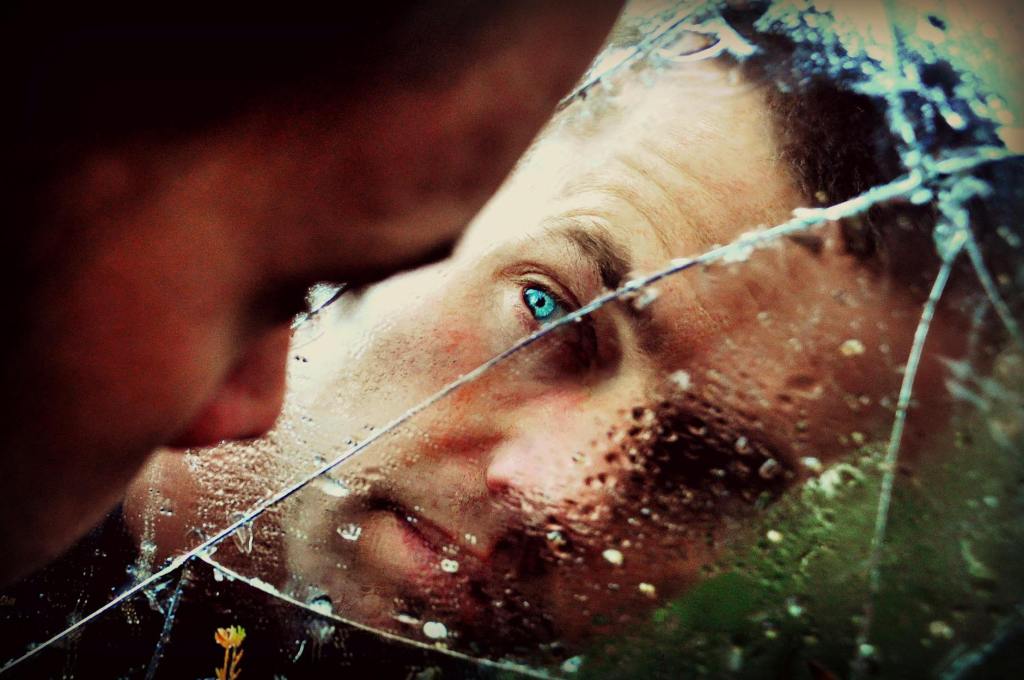
You stand in a room of glass shards. Each shard is a memory, a scar, a whisper of what happened when the world decided you were disposable, unseen, unworthy.
And in the centre of that broken hall stands the Saboteur — a puppeteer pulling your strings, laughing in half-light, commanding your feet to trip, your heart to retreat, your hope to dissolve.
This Saboteur is not foreign. It is born of trauma.
When you were young — exposed, neglected, or abandoned — your nervous system carved out a survival strategy: self-sabotage. Because the world hurt you first. You learnt that to stay safe, you must stay small.
Research tells us: those exposed to childhood physical neglect show significantly higher rates of medically self-sabotaging behaviours.
Likewise, trauma-exposed adults often engage in reckless-or-self-destructive behaviour, which in turn worsens later PTSD symptoms.
So the Saboteur in the mirror is a ghost with a purpose. It whispers: you don’t deserve success. You’ll fail anyway. Better safe than shining. In academia we call this “impostor phenomenon”, “self-handicapping”, “fear of success”. The guilty twin of achievement.
The Core Idea: Self-Sabotage as Maladaptive Survival
Imagine your trauma as a crumbling dam. It bursts. Floods your interior world. The brain shifts into survival mode. It erects barricades, builds secret escape tunnels, runs loops of “better to fail than to be seen to try”.
That dam never fully repairs itself. Instead, a new structure is built: sabotage.
Self-sabotage is not irrational. It is adaptive once — once, you needed to sabotage to protect. Today, you sabotage to stay invisible. To avoid the risk of being hurt, exposed, disappointed. But now it protects nothing except stagnation.
In more academic terms:
- Self-sabotaging behaviours are those that intentionally undermine one’s goals and aspirations.
- Many of these behaviours originate from childhood trauma, disrupted attachment, or neglect.
- These patterns can persist subconsciously, trading potential for safety, brilliance for survival.
The Visual: A Literary Monument
The Saboteur holds a broken mirror up to your face. You think it shows you — but it shows what you fear of yourself.
You see the shadow-you — the one who slipped when the stage lights came up, the one who stayed silent when courage knocked.
You watch your ambition climb like a vine up the wall, and just when it nears the rooftop, the Saboteur cuts it at the roots.
The vine falls. Leaves brown. You breathe, you blink, you tell yourself: it wasn’t safe.
Yet beneath the rubble, there is a seed. And light.
And the possibility that this vine can reconnect to the soil, dig deeper, anchor stronger.
The Science: Why Containing the Saboteur Matters
Letting self-sabotage run unchecked keeps you trapped in trauma’s orbit. The neural pathways of fear & protection keep firing. This means your brain thinks sabotage = safety.
Studies of trauma highlight that self-destructive behaviours reinforce the cycle — more trauma → more sabotage → more vulnerability.
Self-sabotage can manifest as procrastination, perfectionism, avoidance, relationship collapse.
Changing the pattern requires acknowledging the survival strategy behind the sabotage. Only then can the brain rewiring begin: from sabotage to choice.
The Call: Break Your Own Limitations, Reclaim Your Self-Belief
You are not the Saboteur’s puppet. You are the storm-bringer.
Stand in the glass-shard room. Pick up one piece. Feel the cut. Then throw it at the wall. Watch it shatter. Now pick up another. This time: turn it into a mirror of possibility. A place where you see the version of you who is allowed to succeed. To shine. To fail and rise anyway.
Your narrative changes when you begin to contain the Saboteur — not by denial, but by invitation. You say:
“I know you were protecting me. Thank you. But your job is done. I’m not the wounded child any more. I now choose.”
Because the science says: behaviour changes when we convert unconscious survival into conscious choice. We retrain our brains. We plant new roots.
Double the sabotage fighting you? Good. That means you’re close to the edge of growth.
Keep walking.
Final Word
In the theatre of your professional life, the Saboteur sits in the cheap seats—clapping when you delay, cheering when you diminish yourself. Let’s move him to the back row. Mute his applause. Feed him popcorn, if you must, but give him no cue to the spotlight.
Because your story is not about the Saboteur. It’s about the vine that keeps climbing. The rumble of roots underground. The sun through concrete. And when you finally break the glass, step through the reflection, the world will not recognise you. Perfect. Because now you’re you — unshackled, un-sabotaged, un-stoppable.
 Gobinathan Manickam